
CLASSROOM
Rooted
Growth That Holds. Build the most profitable tree, then find out what the leaves you promised actually weigh.
- FORMAT
- Classroom
- DURATION
- 90-minute simulation, half day with debrief
- PARTICIPANTS
- 12–25 in 3–5 teams
- LANGUAGES
- EN
THE PREMISE
Three to five teams. Ninety minutes. One instruction: build a structure that can support rapid growth without collapsing under the pressure.
The leaves are your revenue — your clients, projects and sales. The branches are your channels and delivery. The trunk is your systems. The roots are culture and values, and they earn nothing at all.
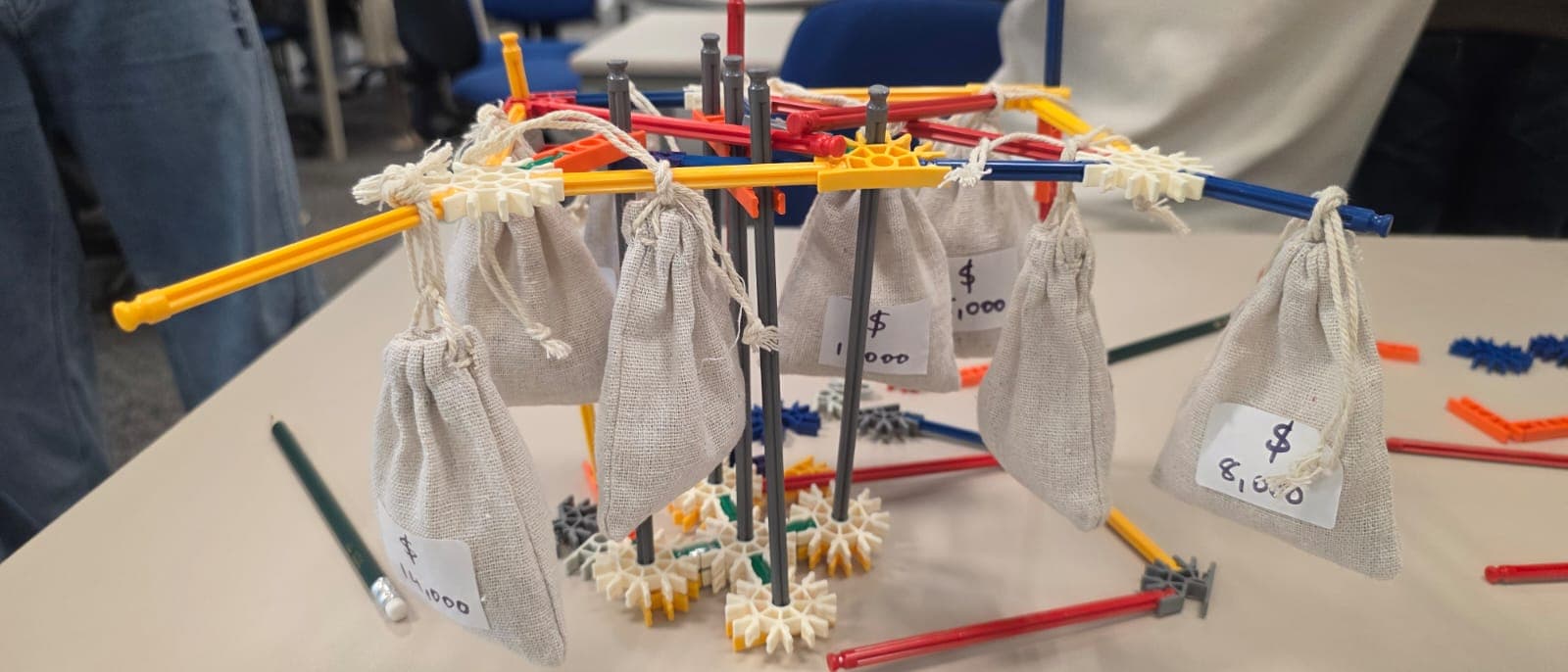
Leaves are not printed cards. They are weighted cloth pouches, each hand-marked with its value, and a $35,000 promise hangs heavier than a $2,000 one. Profit is revenue minus costs minus penalties, and a structure that cannot hold what you promised will say so in front of the room.
What participants do
Everything is bought, nothing is given
Rods and connectors are ordered from the Bank on a purchase order, priced per bundle — and the sturdiest connectors cost thirty times the cheapest. There are no returns on materials or on leaves, so every purchase is a decision you keep.
The Broken Promise penalty
Requesting a leaf registers it to your team, and from that moment it is a commitment. A leaf you cannot hang legally by the end of the round costs you half its value and earns nothing — so an ambitious order at minute two can be the thing that loses you the round.
The market reopens when it said it would not
Round two announces that the market closes for good. Then, with three minutes left, it opens again. What a team does in that window — and what it does to their half-built structure — is usually the most argued-about moment of the debrief.
The building code is inspected, not trusted
Leaves must hang freely, from rods only, touching neither the ground nor the trunk nor each other. A facilitator inspects every tree before scoring, and a leaf that breaks the code earns zero regardless of what it cost to hang.
What they leave with
- 01
Growth has to be matched by capability
A tree that adds leaves faster than it adds branches falls over. Teams experience the failure physically rather than hearing it described, which is why it stays with them.
- 02
A commitment is a physical load
Leaves have weight. Over-promising stops being an abstract scheduling problem the moment a team watches the branch they rushed bend under what they ordered.
- 03
Systems fail quietly before they fail visibly
The trunk shows stress well before collapse, and almost no team inspects it mid-round. The debrief names the organisational equivalents they are currently not inspecting either.
- 04
Opportunity is not automatically good news
The surprise market window is a genuine opportunity arriving at the worst possible moment. Teams confront whether they chase every opening or protect what they have already built.
- 05
Culture is load-bearing
Roots earn no revenue and hold everything. The metaphor is not subtle, and after a collapse it does not need to be.
Inside the box
- Bankers Kit — wheeled hard case with labelled containers of rods and connectors
- Weighted cloth revenue pouches, hand-marked, from $2,000 to $35,000
- Participant Kit — A5 branded zip folio, ring-bound, with laminated reference sheets
- Building Code and Rules cards, laminated, one set per team
- Purchase Order and Team Tracking Sheet pads
- Facilitator Guide v3.2 covering setup, script and debrief
- Master Session deck with countdown, scoring and strategic-announcement slides
Debrief and measurement
The debrief runs longer than the game and is where the session earns its place. It opens on the scoreboard and the photographs of any collapsed trees, then moves to the question teams actually want to argue about: what happened inside your team when the Market reopened.
From there it works through organisational balance — the tension between revenue growth and the structure carrying it — and into systems thinking, identifying the reinforcing loops behind both the growth and the collapse. A benchmarking section closes it, calibrating what the team built against what was possible.
Who it’s for
- Leadership teams in a growth phase
- Organisations that have scaled faster than their systems
- Operating-model and organisational-design work
- Groups where culture is treated as a soft topic
Questions
How many participants?
Twelve to twenty-five, working in three to five teams. The scoring depends on teams competing in parallel, so smaller groups lose the comparison the debrief relies on.
How long does it take?
The simulation itself runs ninety minutes: two fifteen-minute build rounds plus briefing, planning and scoring. With the full debrief it is a half-day session.
Is this physical or digital?
Physical. Teams build with K'NEX and the collapse has to be real for the session to work. There is no virtual version.
What do the parts of the tree represent?
Leaves are revenue — clients, projects and sales. Branches are channels and delivery. The trunk is systems. The roots are culture and values. Profit is revenue minus costs minus penalties.
What is the building code?
Leaves must hang freely from rods only, never from connectors, and may not touch the ground, the trunk or another leaf. Any violation earns zero revenue for that leaf.
How much do materials cost?
Prices vary sharply by piece. Rods run from $400 to $2,000 a bundle and connectors from $150 to $6,000, so the strongest joint is also the most expensive one — and teams have to decide what structural quality is worth.
What happens if a tree collapses?
The team loses half the value of the tree. It is the most instructive thing that can happen in the room, and facilitators are trained not to prevent it.
What space does it need?
A main room with a table per team, a central Bank table, and a separate or visually screened area for the Market. Teams should not easily see each other's structures.
Do facilitators need to be certified?
Yes. Setup accuracy and code inspection both matter, and the surprise market window has to be handled precisely, so certification covers the full script.
Are you a training provider?
License Rooted and deliver it under your own brand. We generate client demand and route it to the partner who owns that market.