
Virtual and Classroom
Shift
Four friends, four traps, and a choice about whether change happens to you or through you.
- Format
- Virtual and Classroom
- Duration
- Virtual 6 hours, classroom 1 day
- Participants
- 2–16
- Languages
- EN PT ES
The premise
Change in our lives is mostly reactive. It arrives through a crisis, a choice, or plain chance — and in every case the same question follows: do we make the change, or not?
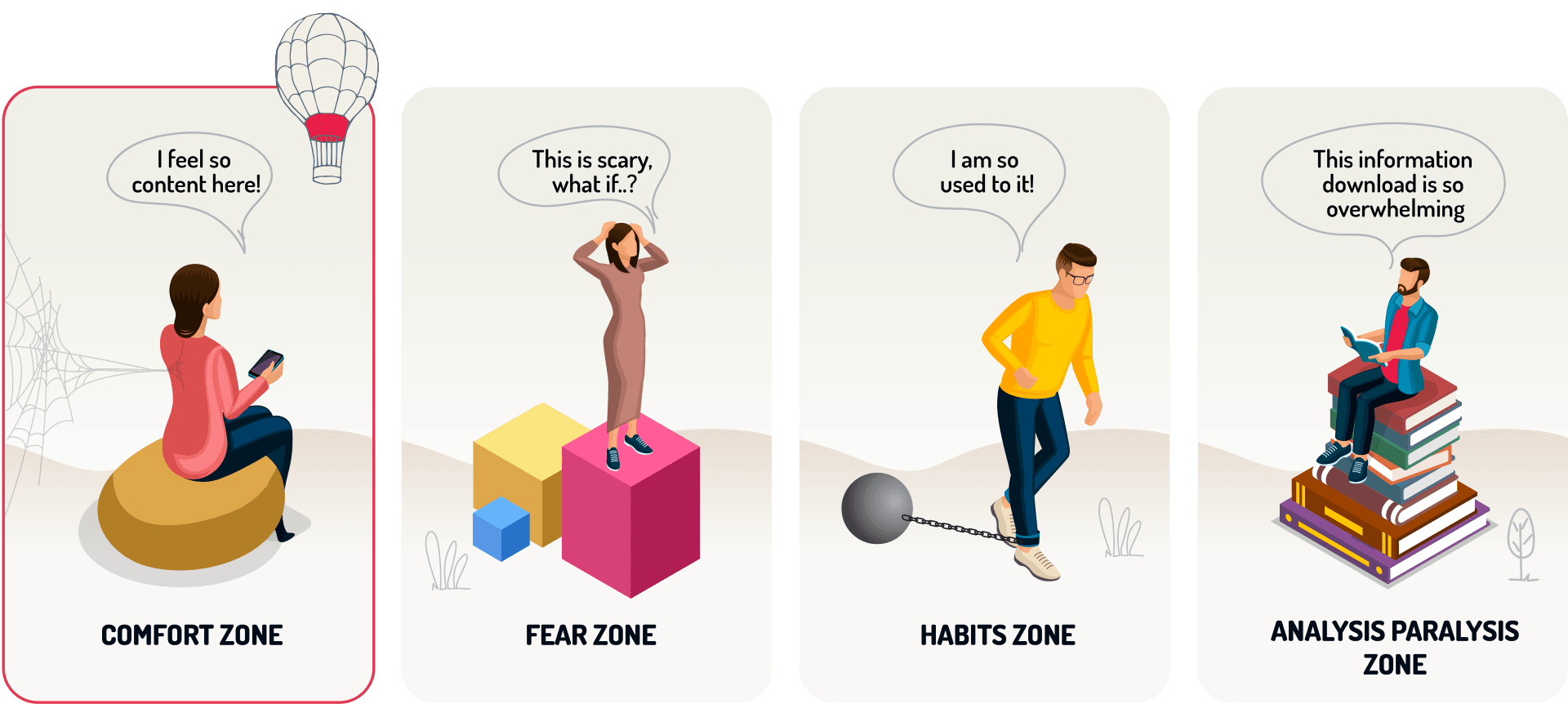
Four friends are caught in four different traps, each one a familiar reason for staying put. Your mission is to free them and move them toward the goal they can see but cannot reach, drawn in the game as a hot-air balloon.
Every trap allows several attempts, and every attempt costs Time. You will not have enough for all of them.
What participants do
Four traps, four different holds
Comfort, fear, habit and over-analysis each keep a person still for a different reason, and each needs a different lever. Teams that apply one approach to all four run out of time.
Time is the currency
Attempts are not free. Teams must decide how much deliberation a trap deserves before acting, which surfaces whether the group defaults to analysis or to motion.
Grounded in established models
The mechanics draw on published work from David Gleicher, Rick Maurer, Charles Duhigg and Stephen Covey, so the debrief connects the game to frameworks participants can read afterwards.
Virtual or in the room
Virtual delivery runs six hours with live facilitation and teams competing against each other in real time. The classroom version runs a day and adds physical materials.
What it looks like
Component flat-lay
Everything in the kit, top-down on a seamless ground, even light
Participants mid-session
Candid, hands on the materials, engaged rather than posed
Inside the box
One component close, showing build quality — the thing a partner is buying
What they leave with
Acting before the crisis forces it
Most change in the game — and outside it — is triggered reactively. Participants practise initiating while there is still room to choose, and see what the delay cost them.
Naming the specific resistance
Comfort, fear, habit and over-analysis look alike from outside and respond to nothing in common. Teams learn to diagnose which one they are facing before choosing a move.
Spending deliberation deliberately
Every attempt costs Time. Groups confront the real trade-off between thinking longer and acting sooner, and discover which way their organisation leans by default.
Building urgency without alarm
Urgency is what moves people out of comfort; alarm is what freezes them. Participants practise the difference and feel how narrow the gap is.
Treating change as something to use
The session reframes change from a thing that happens to you into a differentiator you can be first to. That shift is the point, and it is where the title comes from.
How a session runs
The full format, in order. Half-day versions cut rounds, never the debrief.
- 01
The premise
- 02
First attempts
- 03
The budget bites
- 04
The decision nobody wants
- 05
Scoring
- 06
Debrief
Inside the box
Numbered manifest
The same flat-lay with space around components for numbered callouts
- 01Platform access for virtual delivery, metered by participant credit
- 02The four trap scenarios, each with its own attempt mechanics and Time costs
- 03Character cards for the four friends, printed by the partner for the classroom format
- 04Time tokens and the team ledger, so a group can see its budget draining
- 05Physical scenario materials for the classroom day, shipped as a kit
- 06Facilitator guide: timing, scoring, and the four levers that actually move each trap
- 07Debrief framework mapping each trap to the behaviour it describes at work
- 08Participant workbook, printed by the partner
Debrief and measurement
The debrief
The group in discussion after the game, not during it
The debrief works from the team's own scoring: which traps they attempted first, how much Time they spent before acting, and which friend they left behind.
Those choices map directly onto how the group handles change at work, which is the transfer the session is built for. Client-ready reporting is provided for partners.
Who it’s for
Facilitator running it
Someone leading the room, mid-call
- Teams entering or midway through a change programme
- Groups where resistance is quiet rather than stated
- Individual contributors and managers alike
- Remote and distributed teams, delivered virtually
Designer’s note
Shift was built for the session nobody wants to run: the one after the reorganisation has been announced, where the room has already decided how it feels and a workshop explaining why change is necessary will not move it.
So the game does not argue. It gives you four friends in four traps, each trap a familiar reason for staying where you are, and asks you to get them out. Every attempt costs Time and there is not enough Time for all four. The choice is not whether to help. It is whom, and what you are willing to leave behind.
Running it virtually was a constraint, not a compromise. Most change programmes reach people who are not in the same building, and a simulation that only works in a room excludes exactly the population that needs it most.
What the design exposes is the arithmetic people avoid: deliberation is not free. Teams that spend the first third of the session agreeing on an approach find they have bought that agreement with the Time they needed to act.
Fernando Mendes, HDX Simulations
When another HDX title fits better
Shift is not the answer to everything. If one of these describes your situation more closely, start there instead.
| Title | Participants | Time | Type | Theme |
|---|---|---|---|---|
| Falcon Eye | 15–500 | Half or full day | Immersive experience | collaboration, strategy |
| Flow | 5–50 in 3 teams | 60 minutes, half day with debrief | Immersive experience | collaboration, change |
| Shift | 2–16 | Virtual 6 hours, classroom 1 day | Digital | change |
| Rooted | 12–25 in 3–5 teams | 90 minutes, half day with debrief | Physical | org design, strategy |
| Everest | To be confirmed | To be confirmed | Digital | leadership, strategy |
| Navigator | To be confirmed | To be confirmed | Digital | leadership |
- Classroom
Rooted
The resistance is structural rather than personal. If the organisation cannot carry the change regardless of how willing people are, Rooted shows why.
- Classroom
Flow
The problem is between teams rather than inside individuals — two groups who each think the other is the obstacle.
- Classroom
Falcon Eye
You need to run this for more than fifty people in one room. Shift caps at sixteen.
Questions
What does the virtual format involve?
A fully virtual simulation with live facilitation — teams compete in a gamified setting over video rather than in a room. Shift runs six hours in this format.
Virtual or classroom — which should we choose?
Virtual delivery suits distributed teams and a tighter schedule. The classroom day adds physical materials and a longer debrief, which tends to deepen the transfer.
How many people can take part?
Two to sixteen. Above sixteen the team discussions get too large for everyone to contribute, which is where the value is.
Do participants need prior change-management training?
No. The simulation is the entry point, and the models are introduced through the debrief rather than assumed up front.
Do facilitators need to be certified?
Yes, once per facilitator, valid for 24 months. The certification covers both formats.
Which languages are available?
English, Portuguese and Spanish.
Is the virtual version as good as the classroom day?
For the core mechanic, yes — the traps, the Time budget and the decision about who gets left behind all work identically over video, and teams compete live against each other. The classroom day adds physical materials and a longer debrief, and the extra debrief time is what tends to deepen the transfer. If the group is distributed, run it virtually rather than not at all; the difference is real but it is smaller than the difference between running it and not.
How soon after an announcement should we run it?
After the decision is genuinely final. If the room believes lobbying might still change the outcome, they will use the session to lobby, and you will have run a consultation instead. Two to six weeks after the announcement is the usual window: long enough that the initial reaction has settled, early enough that behaviour has not hardened.
Should it be an intact team or a mixed group?
Intact, if the change affects them as a unit and their manager is in the room. A team that reaches a shared conclusion without the person who signs off has to relitigate it on Monday. Mixed groups work well where the change is cross-functional and two groups each believe the other is the obstacle — but then run them together, not on separate dates.
What do we hand the sponsor afterwards?
Client-ready reporting built from the session itself: which traps the teams attempted first, how long they deliberated before acting, who they left behind, and how that maps to the behaviour the session was booked to change. It is not a satisfaction score. If the sponsor set a measurable behaviour beforehand, the report is written against that.
What if people have been through a change programme already?
It usually helps. A group that has sat through a change model presented on slides recognises the four traps immediately and spends the debrief on their own situation rather than on the concept. The failure mode to avoid is the opposite one — running this as the third session in a series, by which point the room has learned that sessions do not change anything.
Where Shift fits
Bought to address
- Running a real session for 200 people or moreMost experiential formats break somewhere around forty participants. What is usually sold above that number is a keynote with an activity attached, or the same small-group game run twelve times in parallel.
- Getting a team through a change they did not ask forThe announcement has been made, the reorganisation is real, and the room has already decided how it feels. A workshop explaining why change is necessary will not move that. Something has to happen to them instead.
- Growth that is outrunning the structure underneath itRevenue is up and everything is harder. The people who could once make a decision in a corridor now need three meetings, and nobody can point to when that changed.
Where it has run
- A bank's leadership academyTwo days inside a leadership track. The cohort averaged 14% on the assessment before the session and 95% after — every single person improved, and every single person said they would recommend it.Banking — 16 participants — 2026
- A retail bank's national talent programmeFour cohorts in ten days, thirty-three people. Assessment scores went from 58% to 95%, and nineteen of the thirty-one tested had started below 60%.Banking — 33 participants — 2021
- A consumer electronics manufacturerOne day, fifteen people from eight functions who do not normally share a table. Assessment scores went from 30% to 94%, and everybody left with one written commitment.Consumer electronics — 15 participants — 2024
Worth reading first
- How do I make a virtual session feel like a session?
Running a virtual session that is not a webinar
A camera grid is not a room. Everything experiential depends on — peripheral vision, overheard argument, the pause before someone speaks — has to be rebuilt deliberately or it is simply absent.
5 min read - Why does nothing change afterwards?
Why transfer fails, and the one person who decides it
Participants return to a workplace that has not been told anything happened. The variable that predicts transfer better than session quality is whether their manager was involved at all.
5 min read - How do I evaluate beyond the happy sheet?
Measuring behaviour change, not satisfaction
Level 1 tells you whether they enjoyed it. Levels 3 and 4 are the ones your sponsor is paying for, and they are measurable if you set them up before the session rather than after.
5 min read
Are you a training provider?
License Shift and deliver it under your own brand. We generate client demand and route it to the partner who owns that market.