
Classroom
Falcon Eye
A village survives on what it can find, defend and trade. Up to 500 people, one afternoon.
- Format
- Classroom
- Duration
- Half or full day
- Participants
- 15–500
- Languages
- EN PT ES
- In partnership with
- Myndher
The premise
Falkenauge is a remote region rich in resources and equally rich in ways to lose them. Your village is one of several, and none of you has everything you need.
Across a series of timed rounds, teams explore unfamiliar territory, trade with neighbouring villages, defend what they hold and settle disputes in strategic duels. Surprise events arrive without warning and invalidate plans already in motion.
Will you compete or collaborate? Will you manage risk deliberately, or act on impulse? One thing is certain: the path to success is never walked alone.
What participants do
Four roles, held at once
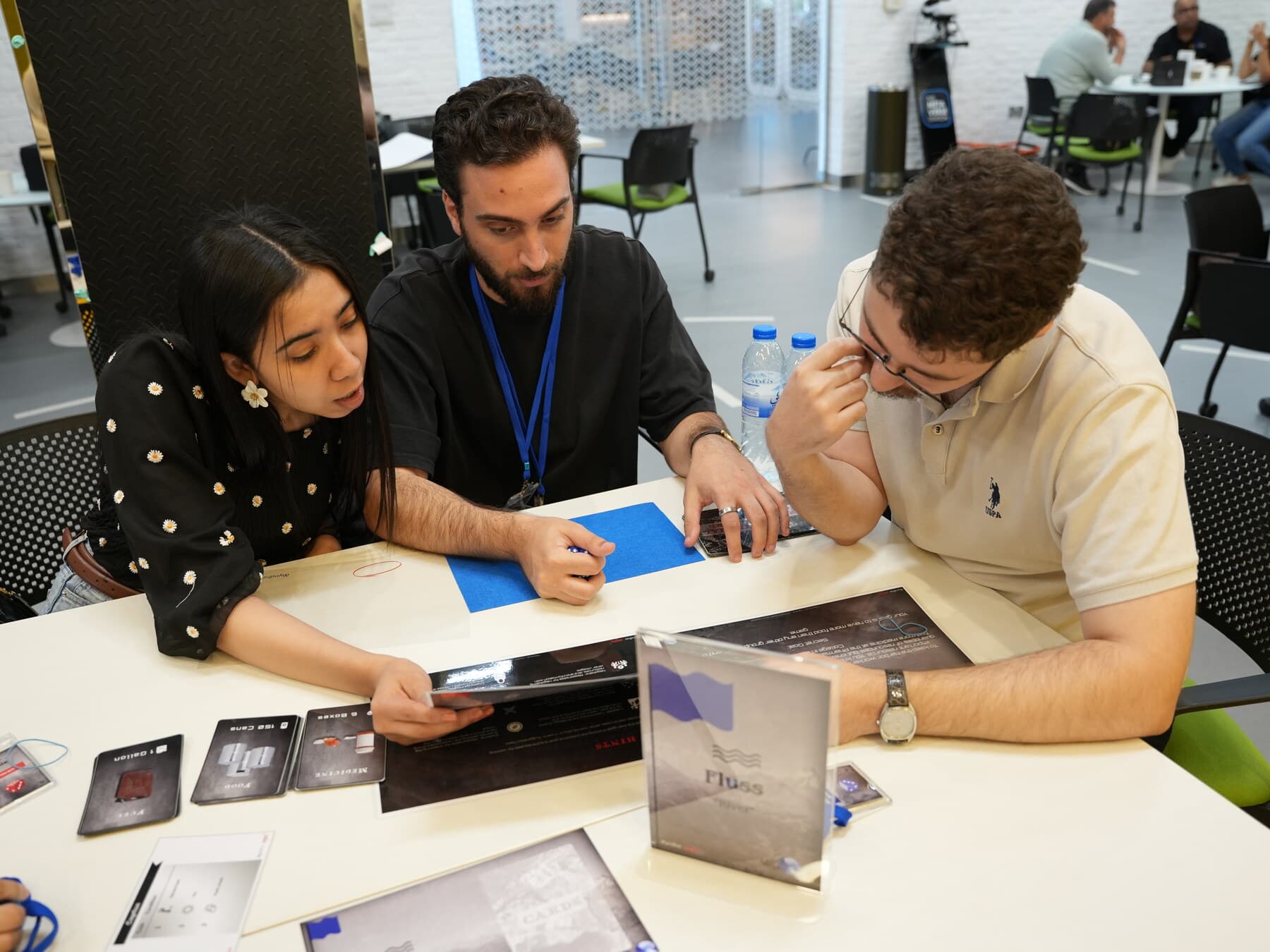
Every village assigns a Leader, a Negotiator, an Explorer and a Defender. The roles carry different information and different authority, and no one person can see the whole board. Decisions have to be made without waiting for permission.
Rounds that run out
Each round is timed. Exploration costs time, negotiation costs time, and a duel can cost you the round. Teams discover quickly that the constraint is not resources but attention.
Other villages are real
Trades only clear when both sides genuinely gain, so bluffing is expensive and short-lived. Reputation accumulates across rounds and villages remember who honoured a deal.
Scales to the room
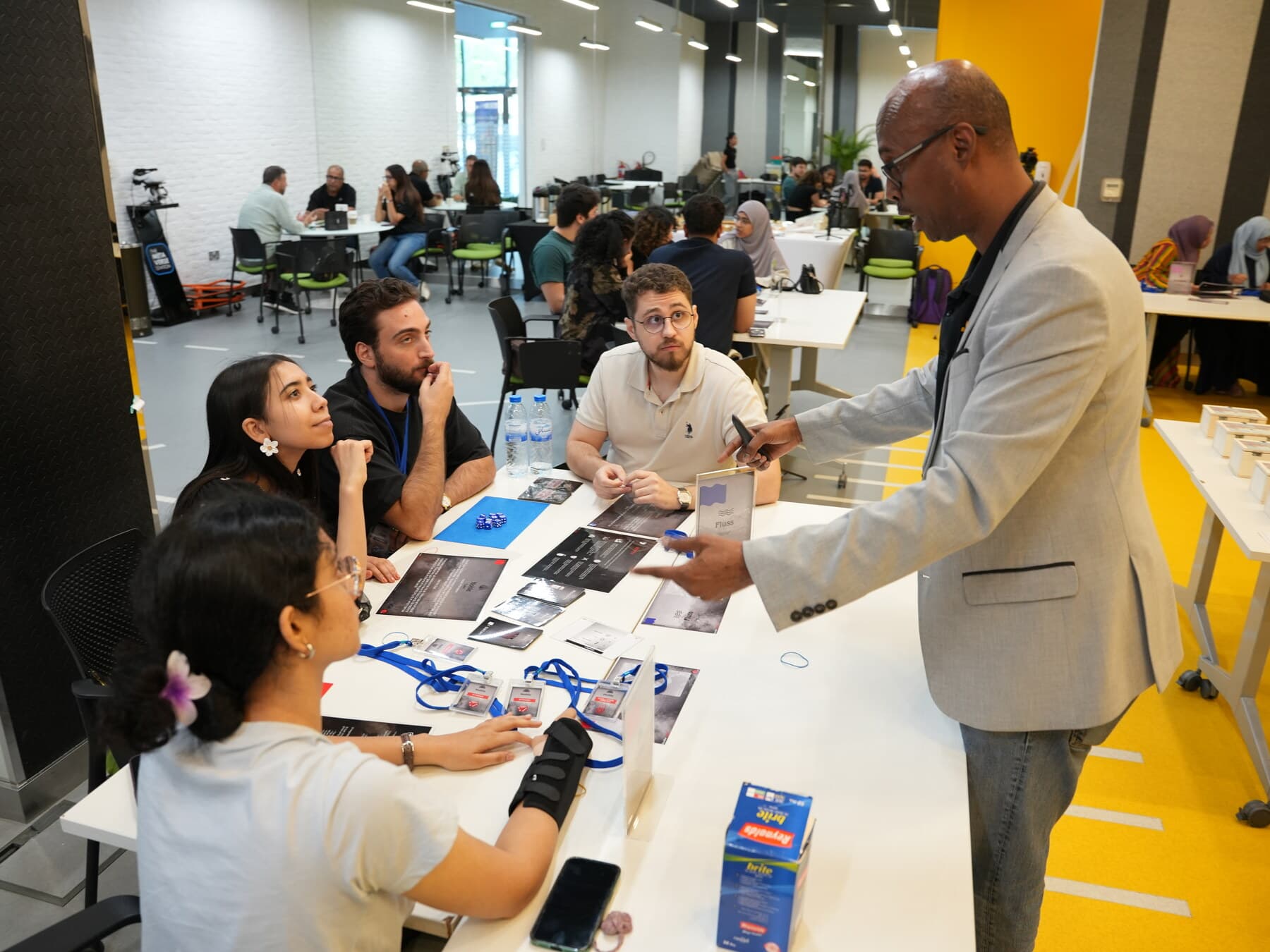
The same design runs for a leadership team of fifteen and for a five-hundred-person conference. Adding villages adds negotiation surface rather than dead time.
What it looks like
What they leave with
Deciding on partial information
No village ever sees the full picture. Participants practise committing to a course of action on what they can actually observe, and learn to name what they are assuming.
Negotiating from an honest position
Trades clear only when both sides gain. Teams that open by overstating their hand lose rounds to teams that are straight, and the debrief makes the arithmetic of that visible.
Spending a scarce resource deliberately
Time is the binding constraint, not materials. Participants confront how much of it they spend on deliberation versus action, and which of the two their organisation defaults to.
Knowing when to compete and when to collaborate
The design rewards neither pure cooperation nor pure competition. Reading which the moment calls for is the central judgement, and it transfers directly to cross-functional work.
Holding a strategy through disruption
Surprise events break plans mid-round. Teams practise distinguishing a plan that needs adapting from one that needs abandoning.
Distributing authority under pressure
Four roles cannot be run through one decision-maker at speed. Leaders experience directly what it costs to hold every call themselves.
How a session runs
The full format, in order. Half-day versions cut rounds, never the debrief.
- 01
Room build
- 02
Framing and roles
- 03
Round one — exploration
- 04
First trading window
- 05
Round two, and the first event
- 06
Duels and defence
- 07
Final round and scoring
- 08
Debrief
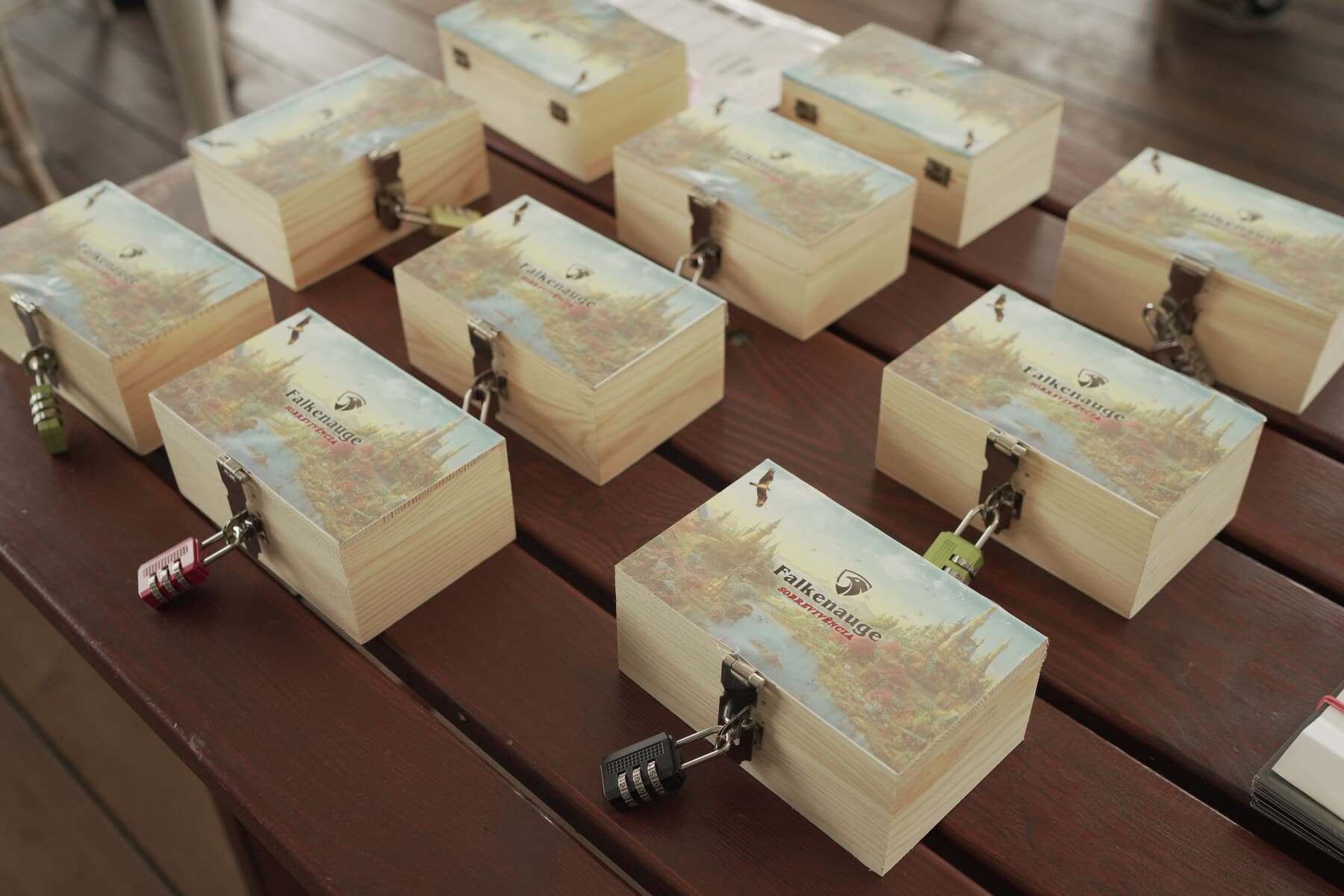
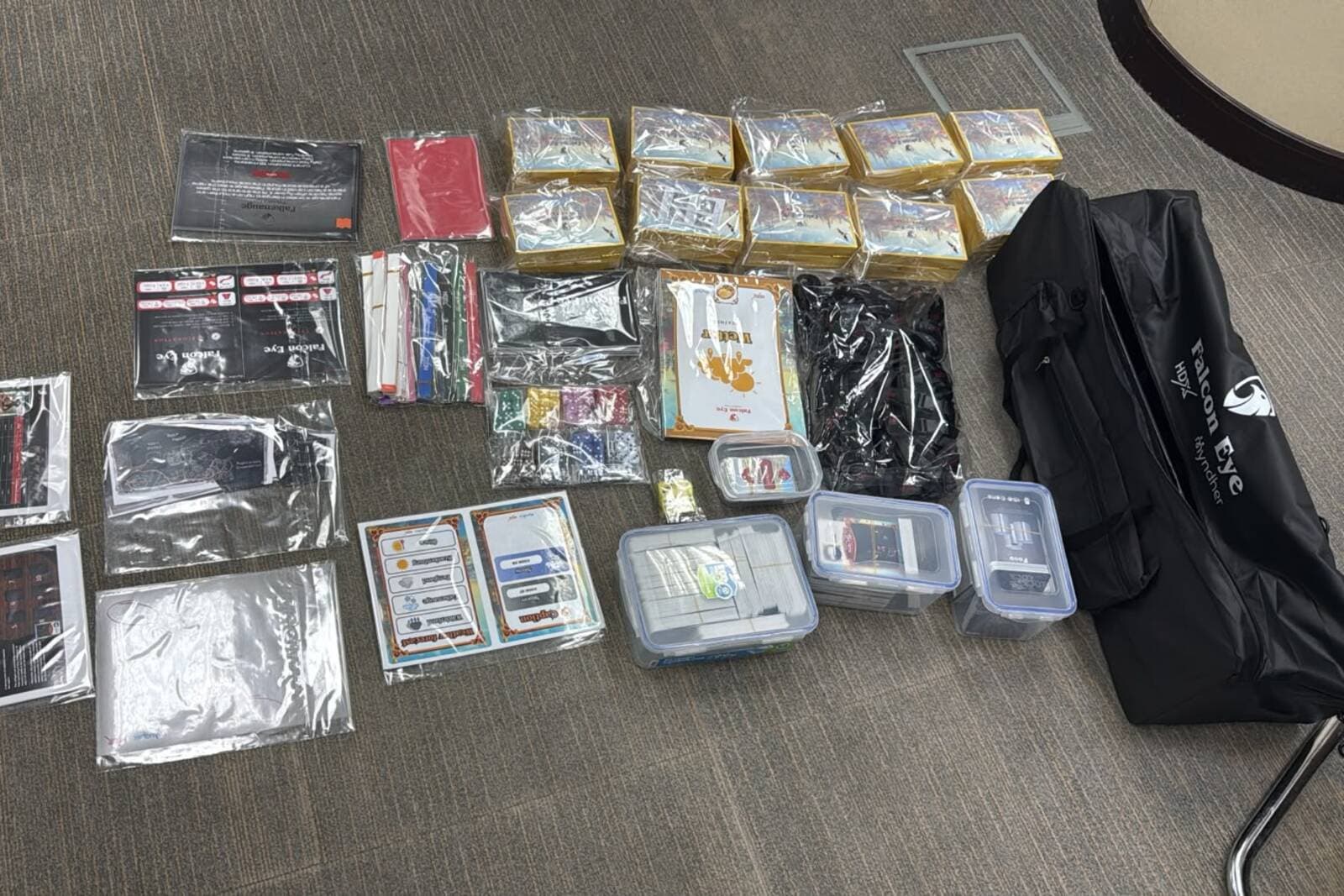
Inside the box
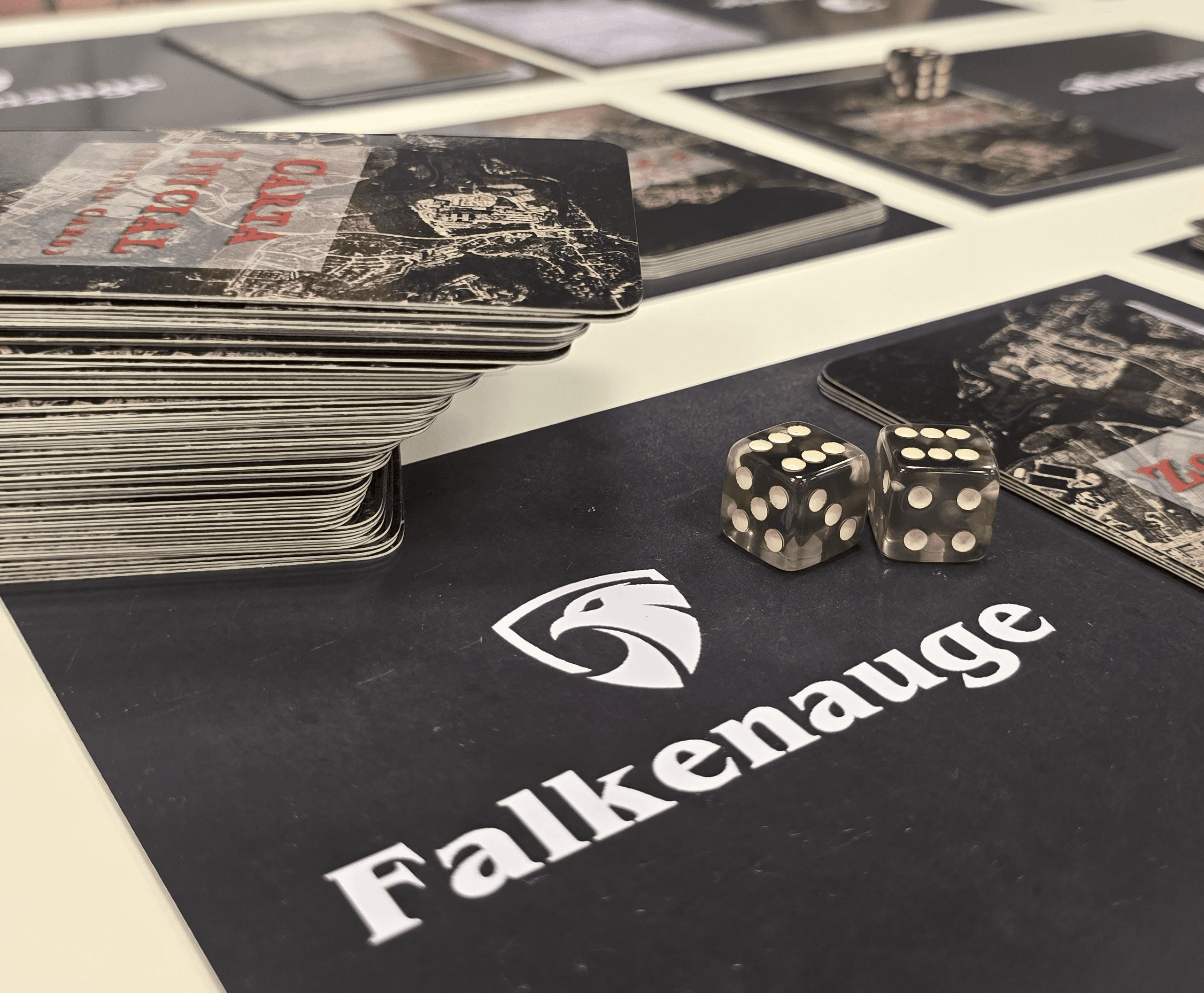
- 01Territory boards, one per village, scaling to 500 participants across up to 40 villages
- 02Resource tokens in four types, quantities set by village count at setup
- 03Role cards for Leader, Negotiator, Explorer and Defender — four per village, each carrying different information and authority
- 04Event deck of timed disruptions, drawn by the facilitator on a fixed schedule
- 05Duel dice and resolution mats, two per village
- 06Trade ledgers for recording agreements between villages, which is what makes reputation stick across rounds
- 07Facilitator guide: round scripts, timing calls, scoring, and the debrief structure
- 08Participant workbook, printed by the partner
- 09Table numbering and signage, printed by the partner
Debrief and measurement
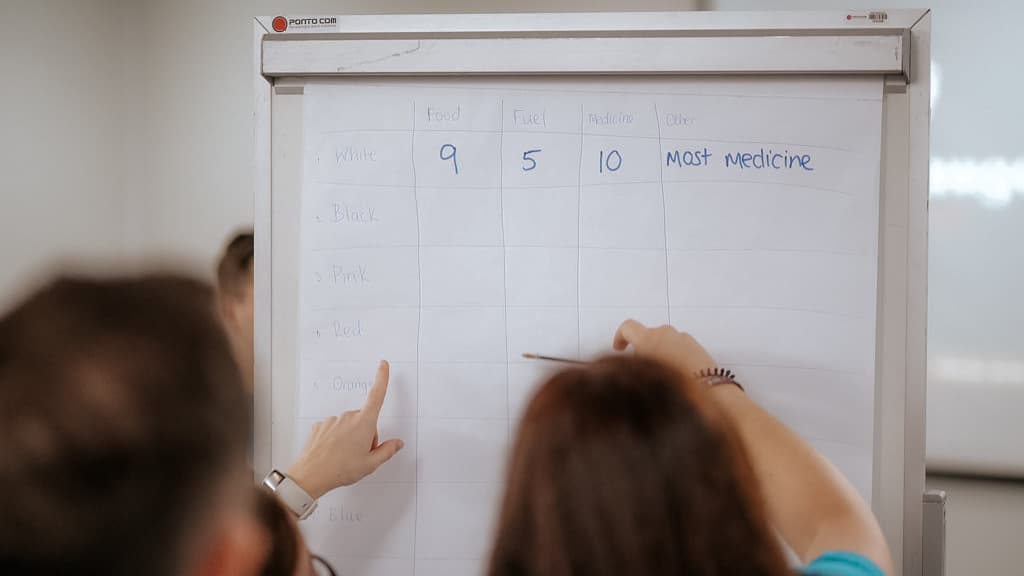
A structured debrief closes the session and is where the learning is made explicit. Facilitators work from the decisions the room actually made — which trades cleared, which villages hoarded, what happened in the round after the first surprise event.
The framework connects three things: what the team decided, what it cost them, and where the same pattern shows up in their own organisation. Client-ready reporting is provided for partners who need to hand something back to the sponsor.
Who it’s for
- Leadership teams working across silos
- Large conference and offsite audiences, up to 500
- Cross-functional groups where negotiation is the real work
- Organisations naming collaboration as a strategic priority
Designer’s note
Most large-group sessions are a keynote with an activity bolted on, or the same small-group exercise run twelve times in parallel. Falcon Eye exists because neither is a simulation. The first has no decisions in it; the second has no scale.
The design problem was making five hundred people matter to each other. Villages hold different resources and none holds everything, so trading is not enrichment around the edges — it is the only route to a score. A village that stays at its own table loses, and it loses publicly, at the end, in front of everyone it did not talk to.
The four roles are the part I would defend hardest. Leader, Negotiator, Explorer and Defender are held at the same time and carry different information, so no one person can see the whole board. Teams that wait for a single decision-maker run out of clock. That is the behaviour the game is built to expose, and the debrief goes straight at it rather than around it.
Surprise events are timed, not random. They land after plans are committed, because the interesting question was never whether a team can plan. It is what a team does when the plan is already moving.
Fernando Mendes, HDX Simulations
When another HDX title fits better
Falcon Eye is not the answer to everything. If one of these describes your situation more closely, start there instead.
| Title | Participants | Time | Type | Theme |
|---|---|---|---|---|
| Falcon Eye | 15–500 | Half or full day | Immersive experience | collaboration, strategy |
| Flow | 5–50 in 3 teams | 60 minutes, half day with debrief | Immersive experience | collaboration, change |
| Shift | 2–16 | Virtual 6 hours, classroom 1 day | Digital | change |
| Rooted | 12–25 in 3–5 teams | 90 minutes, half day with debrief | Physical | org design, strategy |
| Everest | To be confirmed | To be confirmed | Digital | leadership, strategy |
| Navigator | To be confirmed | To be confirmed | Digital | leadership |
- Classroom
Flow
Your group is under fifty and the problem is specifically between two or three teams who will not share information. Flow does that in sixty minutes with a much smaller footprint.
- Classroom
Rooted
The question is structural rather than interpersonal — growth outrunning capability, or a strategy that keeps failing at execution. Rooted makes that physical.
- Virtual and Classroom
Shift
Your group is distributed and cannot be in one room. Falcon Eye has no virtual version and we would not pretend otherwise.
Questions
How many people can actually run at once?
Fifteen at the low end and five hundred at the high end. Above roughly eighty participants the room is split into more villages rather than larger ones, so negotiation surface grows instead of idle time.
How long does a session take?
Half a day covers the core rounds and a compressed debrief. A full day adds further rounds and a substantially deeper debrief, which is where most of the transfer happens.
Is this a physical or a digital simulation?
Physical and in person. Falcon Eye uses boards, tokens, role cards and dice, and depends on people negotiating face to face. There is no virtual version.
What space does it need?
One room large enough for every village to have its own table and for negotiators to move between them. Theatre seating does not work; cabaret or banquet layout does.
Do facilitators need to be certified?
Yes. Certification is a one-off per facilitator and covers round scripting, timing and the debrief framework. It is valid for 24 months and refreshed with a short online module.
Which languages are available?
English, Portuguese and Spanish. Materials are supplied in the language of delivery.
Can it be tailored to our sector?
The resource names and event deck can be themed to a client context. The underlying mechanics stay fixed, because they are what makes the debrief comparable across groups.
What happens if two villages simply refuse to trade with each other?
It happens, and the design expects it. A village that isolates itself can survive a round or two on what it holds, then finds the next event has removed something it cannot replace. Nobody is forced to trade; the scarcity does the work. In the debrief this is usually the group's own strongest example of a cost they chose without noticing they were choosing.
Do we need a facilitator for every village?
No. One lead facilitator runs the room, the timing and the events regardless of size. Additional facilitators are needed for distribution, scoring and table-level debrief, and the count rises roughly with every four to six villages rather than with every table. Tell us your group size and we will tell you the number, including where the thresholds sit — a group just past one costs the same as a group well into the next band.
Can it run in half a day?
Yes, with fewer rounds. What does not get cut is the debrief. A half-day session runs three rounds instead of five and keeps the full reflection, because the rounds produce the material and the debrief is what makes it transferable. Any provider proposing the reverse has misunderstood what they are selling.
Where Falcon Eye fits
Bought to address
- Running a real session for 200 people or moreMost experiential formats break somewhere around forty participants. What is usually sold above that number is a keynote with an activity attached, or the same small-group game run twelve times in parallel.
- Two teams that have to work together and do notNobody in either team would say they refuse to collaborate. They would say the other team is slow, or unrealistic, or does not understand the constraints. Both are describing the same structure from opposite sides.
- Developing leaders who have never been tested under pressurePromotion is usually the first time anyone finds out how a person decides with incomplete information and a clock running. That is an expensive place to discover it.
- A strategy everyone agreed with and nobody executedThe offsite went well. The slides were clear and nobody objected. Six months later the strategy is a document, not a set of decisions anyone has made differently.
Worth reading first
- How do I hold a room this big?
Facilitating two hundred people without losing the room
Past about sixty participants, everything that worked in a classroom stops working. The fix is structural, and most of it happens before anyone arrives.
6 min read - How many people should be in the room?
What group size actually changes
Twelve, forty, two hundred. The same simulation produces a different intervention at each, and the number in the brief is usually treated as a logistics detail.
5 min read - What do I do when it stops working?
What to do when a session goes wrong mid-round
A team refuses to play. The timing collapses. A senior participant takes over the room. None of these are rare, and all of them have a move.
6 min read
Are you a training provider?
License Falcon Eye and deliver it under your own brand. We generate client demand and route it to the partner who owns that market.